4 Best Retirement Calculators (Free & Paid)
We earn a commission from the offers on this page, which influences which offers are displayed and how and where the offers appear. Learn more here.
Retirement calculators can help us plan and prepare to retire. When we are years away, these online tools can help us determine how much we should be saving. As we approach our time to retire, they can help us understand how much we can spend each year in retirement without going broke.
Not all retirement tools, however, reach the same result. They take different approaches to what is a complex series of calculations and assumptions. One study examined five popular retirement planning software packages and found stark differences in outcomes. As a result, it recommended that individuals use “multiple programs before implementing an action plan based on the results.”
To that end, here is a list of the best retirement calculators. Note that I have used each of these tools for years, as well as many others that didn’t make the list. I also know the founders of most of these tools.
My Top Picks
Of all the retirement planners available today that I’ve used, three stand out among the rest:
Empower
Empower’s Retirement Planner is free and extremely easy to use. It runs a Monte Carlo simulation on your plan, and you can create multiple plans and compare them. You can also model different income and expense scenarios. And if you connect your accounts to Empower, it automatically brings them into the analysis. It’s particularly powerful for those who are more than five years from retirement, and I used it for many years.
Boldin
Boldin is what I use now that I’m semi-retired. It allows you to model virtually every aspect of retirement, including Social Security, pensions, and even Roth IRA conversions. There’s a free version, and PlannerPlus is $14/month billed annually after a 14-day free trial.
ProjectionLab
I’ve used ProjectionLab since its founder, Kyle Nolan, first launched it. It offers some of the best charts, graphs, and user interface of any retirement planner, and its tax analysis and “what-if” scenarios are excellent. There’s a free version, and Premium is $129 a year.
Best Retirement Calculators
1. Empower
Best free retirement calculator
Empower is my favorite investing and retirement tool. In addition to being totally free, it’s extremely easy to use and rich in features. Once a user connects their 401k, IRA, and other investment accounts, Empower pulls all the data from the accounts into its Retirement Planner.
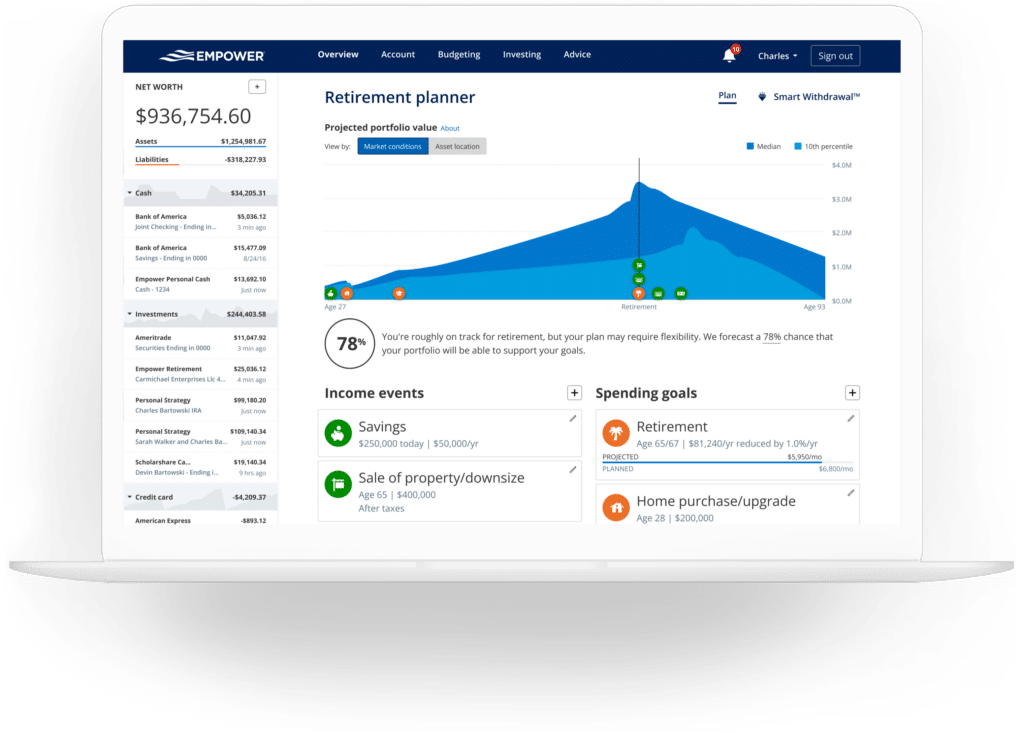
The Retirement Planner then allows users to model both income events (e.g., savings, sale of real estate, social security, pensions) and spending goals (e.g., retirement spending, travel, education). Users can also set up multiple scenarios to compare, such as retiring at different ages. Empower then runs the data through a Monte Carlo simulation and reports the likelihood of the plan’s success.
Here’s a video walk-thru I did of Empower (it was called Personal Capital when I recorded the video):
Unique Feature: Users can create multiple scenarios (e.g., different retirement dates, different social security strategies) and compare how successful each will be.
2. Boldin (formerly New Retirement)
Boldin is not for the faint of heart. The tool, which has both a free and paid version, enables users to model just about every aspect of retirement. For example, users can model social security claiming strategies, medicare coverage, annuities and pensions.
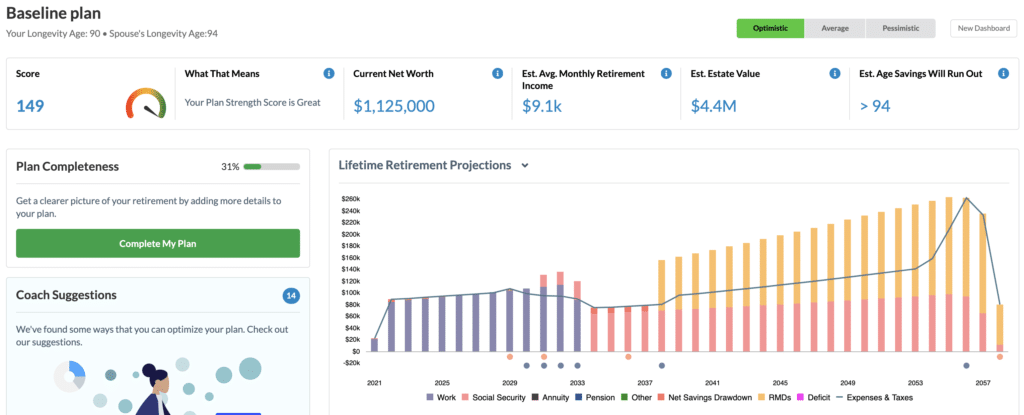
Boldin handles the complexity of retirement planning in two ways. First, users can follow a quick start guide, answer a few simple questions, and have a complete snapshot of their retirement readiness in under five minutes.
Following that, users can dive into the details of everything from future healthcare costs to retirement savings contributions. Boldin enables users to link investment and retirement accounts or enter them manually.
It projects your future income, expenses, and net worth, and it presents the results in user-friendly charts and tables. You can set income and expenses on a monthly, yearly, or one-off basis.
Boldin offers a free version, and its PlannerPlus version is $14/month billed annually after a 14-day free trial.
While I like all of the tools on this page, Boldin is what I use to model our retirement plan. I recorded a live working session on Boldin that you can check out here:
Unique Feature: Boldin includes a Roth IRA conversion calculator to help users determine when and how much of a traditional IRA should be converted to a Roth IRA.
3. Projection Lab
Projection Lab is another favorite of mine. I’ve met the developer, Kyle Nolan, and I can tell you he puts 100% of his energy into this tool. It’s easy (and fun) to use, and it produces excellent charts and graphs.
It works similar to Boldin. You enter your income, expenses, and investments. It can handle a multitude of account types, including traditional and Roth 401k/403b accounts, Roth and traditional IRAs, HSA accounts, and, of course, taxable investment and savings accounts.
You also enter information about your retirement plans. This would include when you and your significant other if you have one plan to retire, when you plan to take Social Security, and your estimated life expectancy. You can also set other financial goals, such as when you’ll achieve financial freedom, getting out of debt, buying a home, and college education for your children.
Projection Lab then crunches the numbers in your base plan. Here’s an example of what the results look like:
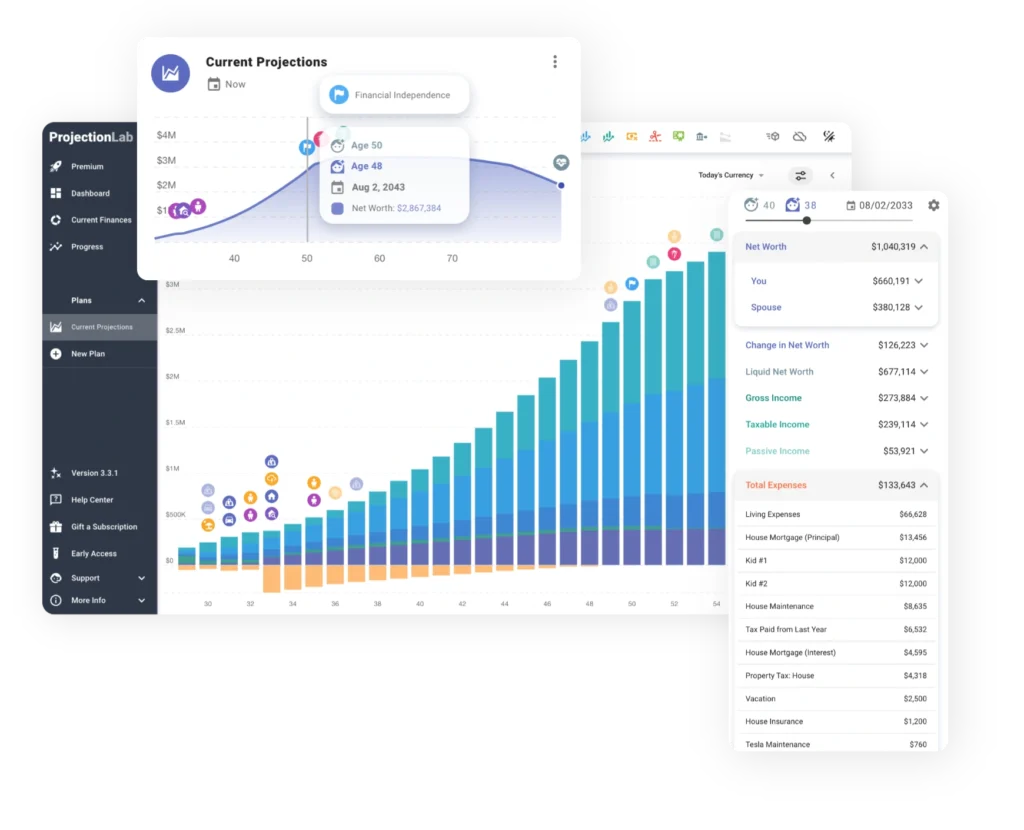
One feature unique to Projection Lab is the ability to model different retirement withdrawal strategies, such as the 4% Rule, Guyten-Klinger, and Variable Percentage Withdrawal.
Its tax analysis is excellent, and its “what-if” scenarios are best in class. It also runs both Monte Carlo and historical simulations. It’s an excellent tool for retirement planning as well as overall financial planning.
Here’s my video review of Projection Lab:
I should note that Projection Lab has added some nice features since I recorded this video. Kyle is doing a great job with this planner.
You can get the Basic plan for free, or the Premium plan with more features for $129 per year, after a 7-day free trial.
10% Discount: I have a promo code for a 10% discount. At the request of ProjectionLab, the discount code is only available for those who subscribe to my newsletter, which you can do here. The newsletter is free, goes out every Sunday morning, and you can unsubscribe at any time. After you subscribe, you’ll receive an automated email with the ProjectionLab discount code.
4. Maxifi
Maxifi is a retirement planner based on the economic model of “consumption smoothing.” This model assumes that individuals want to spend the same amount of money each year after accounting for inflation. What does that mean in practical terms?
There are two ways to think about retirement planning. First, you could calculate your chance of success based on how much you want to spend each year. Second, you could calculate how much you can spend each year based on your assets and income sources. If that sorta sounds like the same thing, it is. But economists strongly believe that the second approach is better. I don’t; I like both approaches. But then again I majored in English.
Anyway, Maxifi was developed by an economists who has very strong views in favor of consumption smoothing. In my experience, retirees do not want to spend the same after-inflation dollars each year in retirement. Spending goes down as we age. But I think evaluating a retirement plan in this way is perfectly fine. In fact, the planning software above allows you to evaluate a plan both ways, which is just one reason I favor them.
That said, Maxifi does do a lot of sophisticated calculations behind the scenes. In fact, it can take 10 minutes or more to run various scenarios. I personally find it to be the hardest software on the list to use, but others really like it.
FAQs
Are Retirement Calculators Free?
What’s the difference between a retirement calculator and retirement planning software?
Retirement planning software is more robust than a retirement calculator. They can factor in far more details, such as different social security claiming strategies, Roth conversions, and Medicare premiums. They can also run ‘what-if’ scenarios. In contrast, a retirement calculator uses just a few inputs to give one a high-level view of their retirement readiness.
What is the best retirement calculator?
While the best retirement calculator will vary based on one’s personal preferences and specific goals, I believe Empower’s Retirement Planner is the best. It’s free and offers a good combination of features and ease of use.
