
The Best Expense Trackers (Updated March 2026)
We earn a commission from the offers on this page, which influences which offers are displayed and how and where the offers appear. Learn more here.
By Rob Berger, JD | Last Updated March 6, 2026
Where does all your money go? If you often ask yourself that question, it’s time to consider an expense tracker. An expense tracker can tell you exactly what you’re spending money on, identify financial habits, and reduce unnecessary spending.
My Top Picks for Expense Trackers


Our Top Expense Tracker Apps in 2026
1. Monarch Money
Monarch Money is arguably the prettiest expense tracker out there, with a slick interface and colorful charts. It’s also one that the founder of this blog, Rob Berger, personally uses.
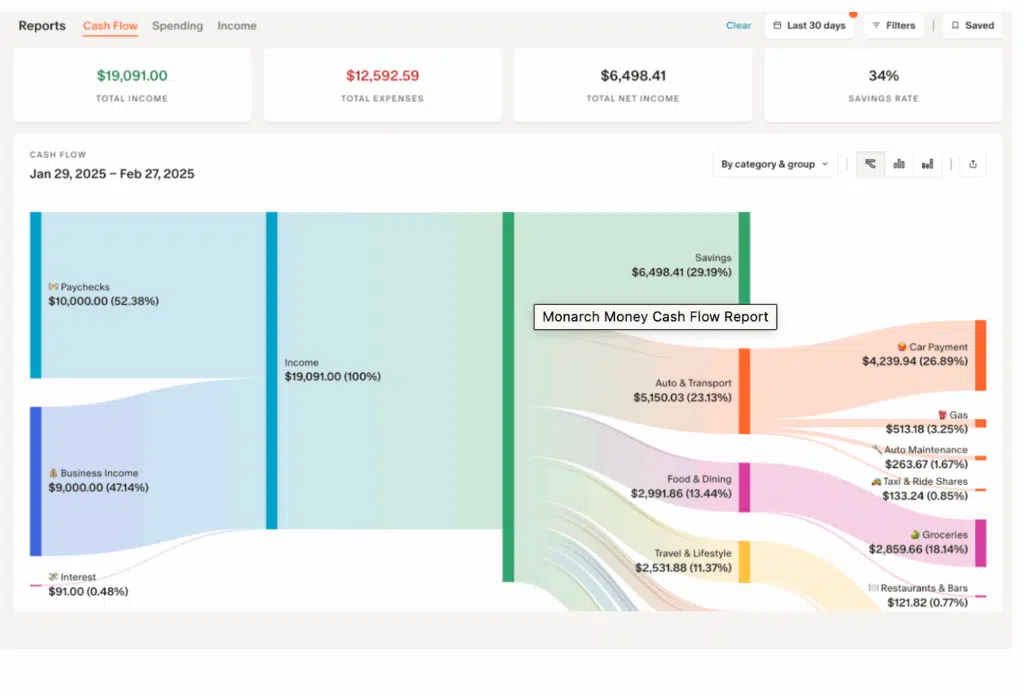
If you link all of your accounts, you get a snapshot of everywhere your money goes. Cash flow insights can tell you where you tend to spend money so you can adapt (or not). Monarch Money can even sync with Amazon so you can categorize these purchases, instead of just seeing “Amazon” or “shopping” as a category. This is such a great feature, that we dedicated an entire article to it that you can read here.
Your partner can add all of their accounts as well, so you can both see where your money goes and you can each have a separate login.
New AI Assistant: Ask AI about your budget, transactions and other data inside Monarch.
New Receipt Scanner: Scan or upload receipts and Monarch automatically matches it to the transaction, extracts line items, and recategorizes expenses.
Also read: Best Budgeting Apps for Couples
Cost: $14.99 a month, or $99 a year. There is a free 7-day trial, and readers of Robberger.com can get 50% off their first year with code ROB50.
Best For: Couples or families managing shared expenses and tracking trends.
Read more about Monarch Money in our Monarch Money Review.
2. Simplifi by Quicken
Simplifi by Quicken is a simplified version of the more comprehensive Quicken Basic. With Simplifi, you can track everything you spend and get easy-to-read reports on it all. The watch list is a helpful feature: if you’re worried about spending too much on groceries, you can put that category on a watch list. Then, Simplifi will keep a running tally of what you spend on groceries, as well as all the money you have left.
Simplifi is affordable (although there’s no free trial). It’s about $3 a month, which is one of the cheapest expense trackers out there.
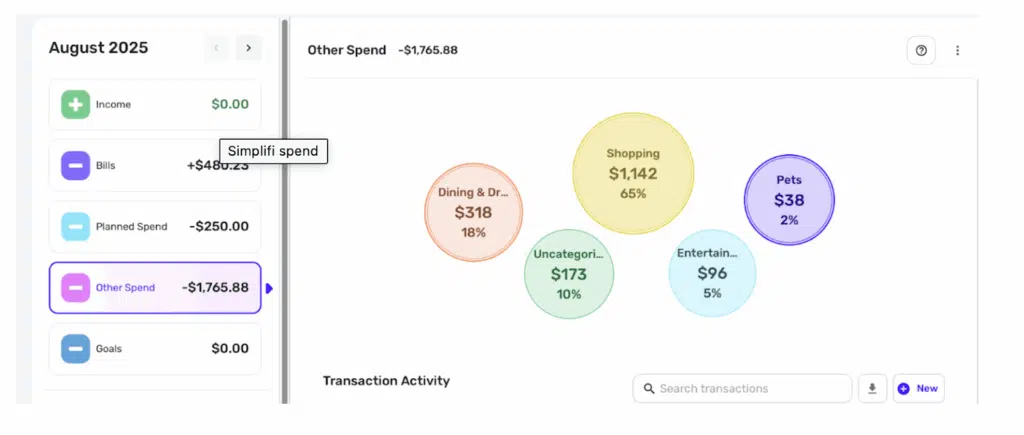
Cost: $2.99 a month for the first year (regularly $5.99/month), billed annually. There is no free trial, but there is a 30 day money back guarantee.
Best For: Visual thinkers and users who prefer a simple interface.
Read more about Simplifi in our Simplifi Review.
3. Empower
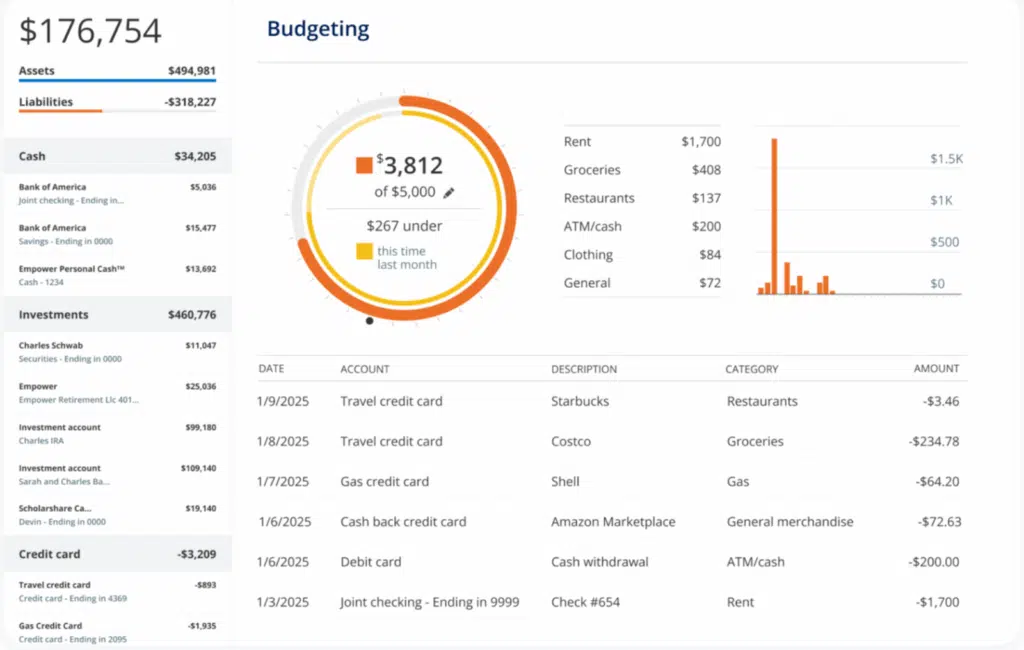
Technically, Empower is more of an investment tracker than it is an expense tracker, but it does have budgeting and expense tools, and best of all, they’re free. You can link all of your accounts–checking, savings, credit cards, loans, mortgage, retirement accounts–to this one platform giving you an overview of your entire financial picture.
Empower automatically categorizes your transactions and you can tag transactions if you want. It doesn’t always get the categories right, but making adjustments is easy and should take just a few minutes a month.
Cost: Free
Best For: Users who want an overview of spending alongside investment performance and net worth tracking.
Read more about Empower in our Empower Review.
4. Rocket Money
Rocket Money is an expense tracker and app that promises to find and cancel subscriptions for you and negotiate bills on your behalf. Those are both included in the Premium version, but there is a free version which offers expense tracking and budgeting.
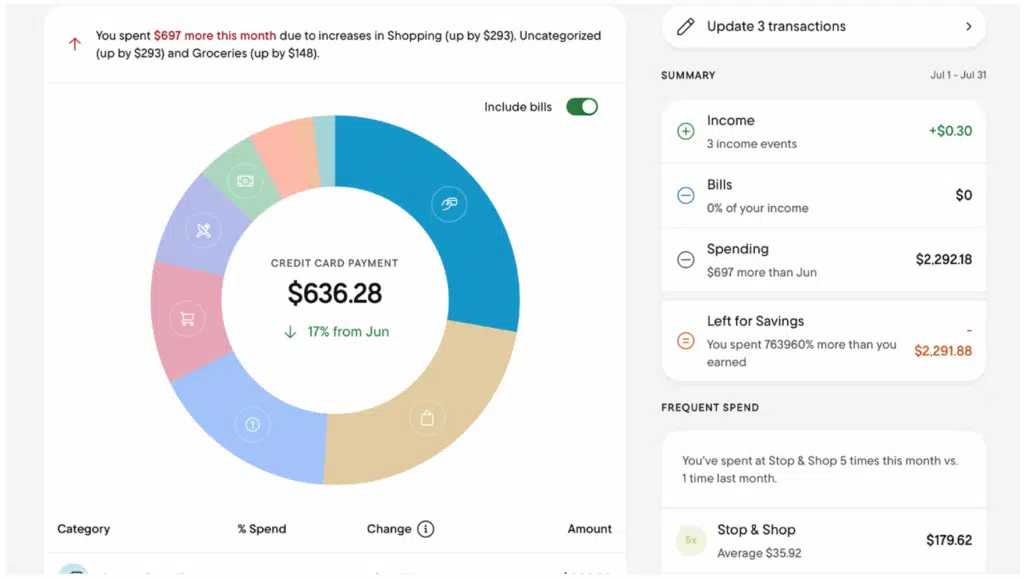
Cost: Free for the basic version or users can choose to pay between $7 and $14 for the Premium version, depending on what you feel the service is worth. There is a also a 7-day free trial of Premium.
Best For: Users who want to get control over hidden and recurring expenses.
Also read: Best Subscription Manager Apps to Track and Cancel Recurring Charges
Read more about Rocket Money in our Rocket Money Review.
5. PocketSmith
PocketSmith is a comprehensive budget tracker and personal finance tool that promises to forecast what your finances look like years in the future. Most features are for desktop only, but there is a mobile app that provides basic expense tracking functions so you can keep tabs on the go.
The calendar feature can tell you exactly how much money you’ll have on any given day. The higher tiers can track foreign currency and can forecast 60 years into the future!
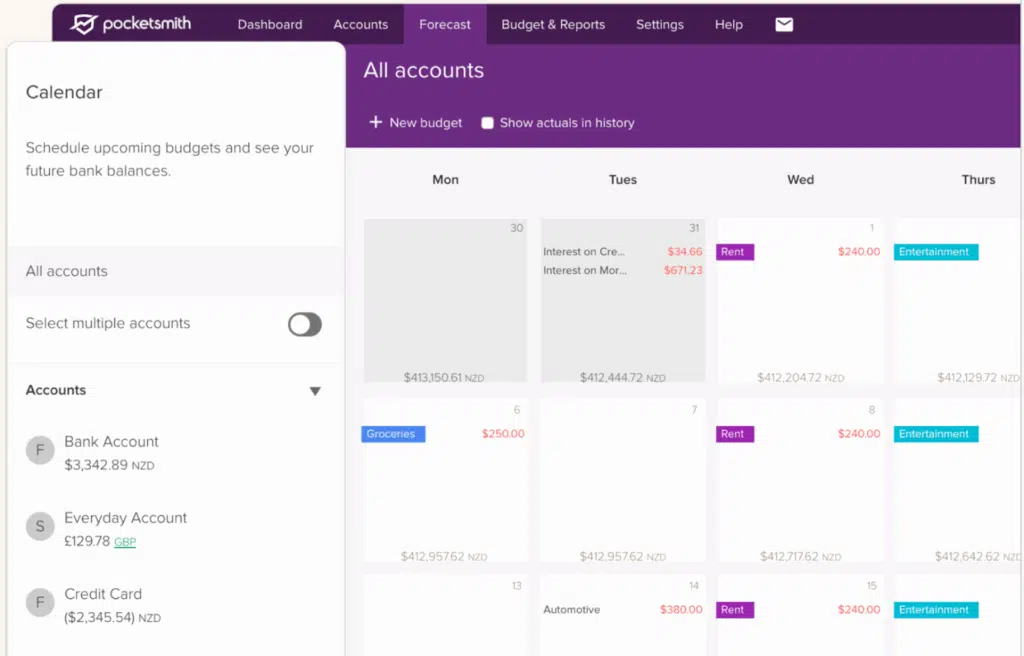
There is a free version, but it’s missing most of the features that make a good expense tracker, including the ability to sync with your bank accounts. You’ll have to enter your transactions manually.
Cost: There are three different pricing tiers, each tier is billed annually. Foundation is $14.95/month, Flourish is $24.95/month, and Fortune is $39.95/month. There is also a 14-day money back guarantee.
Best For: People who want to track expenses with a time-based lens.
6. Origin
Origin is a powerful all-in-one financial management platform. Users can track spending, monitor investments, file taxes, plan their estate, and even connect with a CPA. That’s a lot of financial muscle in one place, and it’s exactly what makes Origin stand out among personal finance tools.
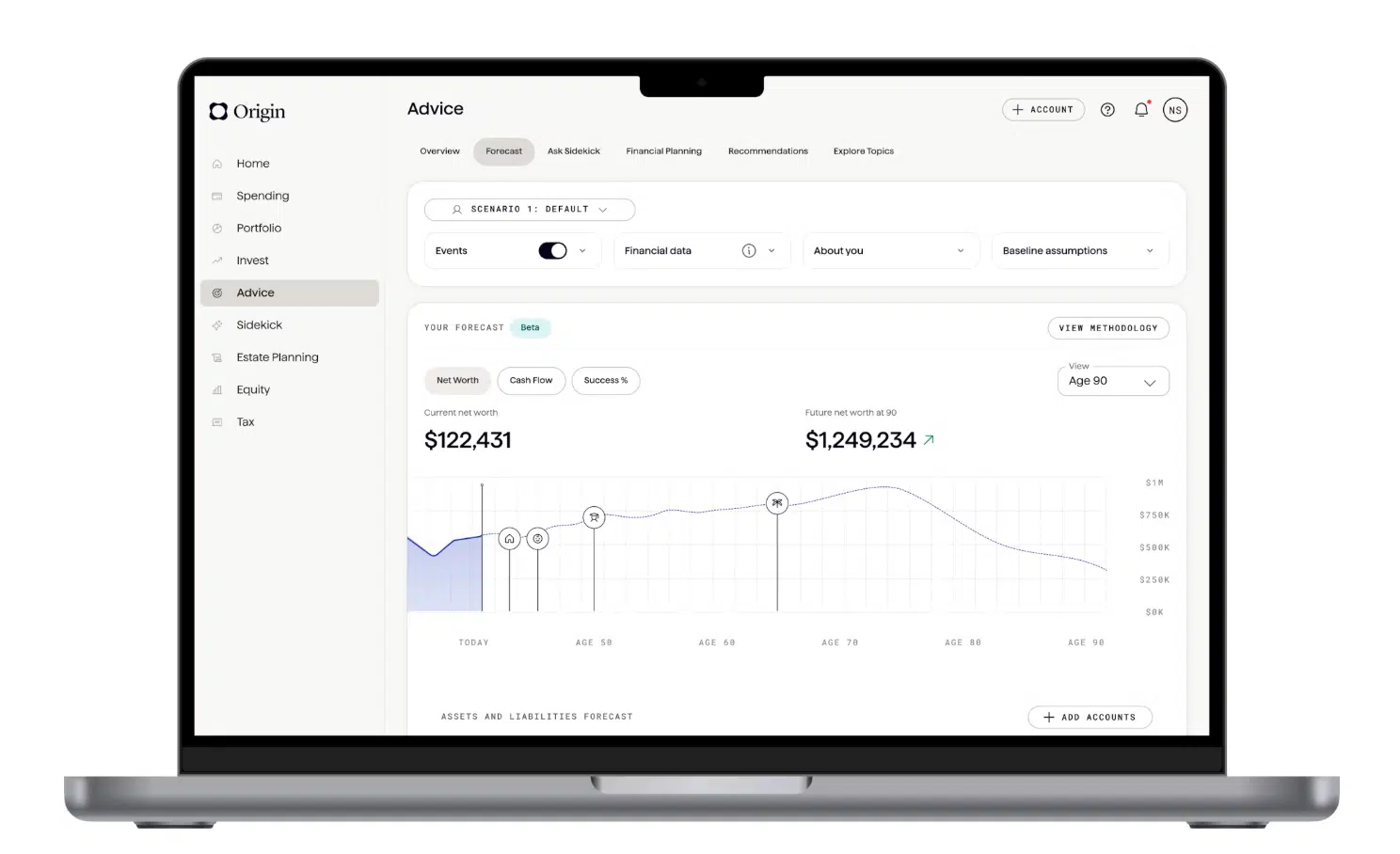
Origin also features a built-in AI assistant, Sidekick, that provides personalized insights and recommendations to help you stay on top of your money. And if you prefer a human expert, you can schedule sessions with a Certified Financial Planner for an additional cost.
Where most apps focus on one aspect of financial management like budgeting, investing, or retirement, Origin offers it all. You can file your taxes, create a will, set up a trust, and even open a high-yield savings account, all from the same platform. Most of these features come standard with an Origin subscription and advanced services like estate planning, tax pro support, and CFP sessions will require an additional fee.
Cost: $12.99 per month, or $99 per year (billed as $8.25 per month). Includes a 7-day free trial.
Best For: Individuals or couples who want a single platform to manage every part of their financial life, from daily spending to long-term planning.
Read more about Origin in our Origin Review.
Expense Trackers vs Budget Apps
Before we discuss the best expense trackers, let’s define what an expense tracker is and how it differs from a budgeting app.
Expense trackers are backward-looking. They analyze and categorize past transactions to help users understand spending habits. You’ll record every expense so you can see patterns and, perhaps, make adjustments. Expense trackers can help you discover if you’ve been spending $75 on breakfast burritos every month.
Budgeting Apps are forward-looking. They focus on planning future spending, often with envelope-style or goal-based systems. If you have a budget, you have a plan. The only trick is to stick to it.
What Makes a Great Expense Tracker?
The best expense tracker is one that you will use. Whether you prefer a slick interface or just basic information laid out so it’s easy to read, there’s a tracker out there for you. That said, here are a few great features to look for:
- Automatic syncing with bank accounts and credit cards
- Clean, categorized transaction views
- Flexible tagging and notes
- Customizable categorization features
- Customizable reports (monthly, category-wise, etc.)
- Alerts for irregular spending or large transactions
- Mobile and web access
- Forecasting (predicting future spend based on past spending)
- AI powered spending insights
- Export to Excel
You probably don’t need or want all of these features, but it’s good to know what’s out there.
How to Choose the Right Tracker for You
There’s no question that there are a ton of expense tracking and budgeting apps out there, with more launching all the time. How do you decide on one? Here are some questions you may want to ask yourself:
- Do you want automatic bank sync or manual entry?
- What kind of categorization features (with tags, colors, geography, etc) do you prefer?
- Are you looking for basic spending insight or detailed trend analysis?
- Do you want projection/forecasting abilities?
- Do you need to share expenses with a partner or household?
- How important is investment integration?
Lastly, you need to find the app easy to use and dare we say, even fun. If an app feels like a chore to use, it’s easy to ignore, and you likely won’t use it at all.
Final Thoughts
Expense tracking is an excellent way to keep tabs on your money and gain some insights into your spending. You don’t have to budget, but knowing the comings and goings of your money is crucial to financial solvency. Of course, many expense tracking apps have other features as well, from budgeting to net worth, and those features are easy to add as you become more comfortable. Before you know it, you’ll be a financial wiz.
